Hancock County Dog Registration Information
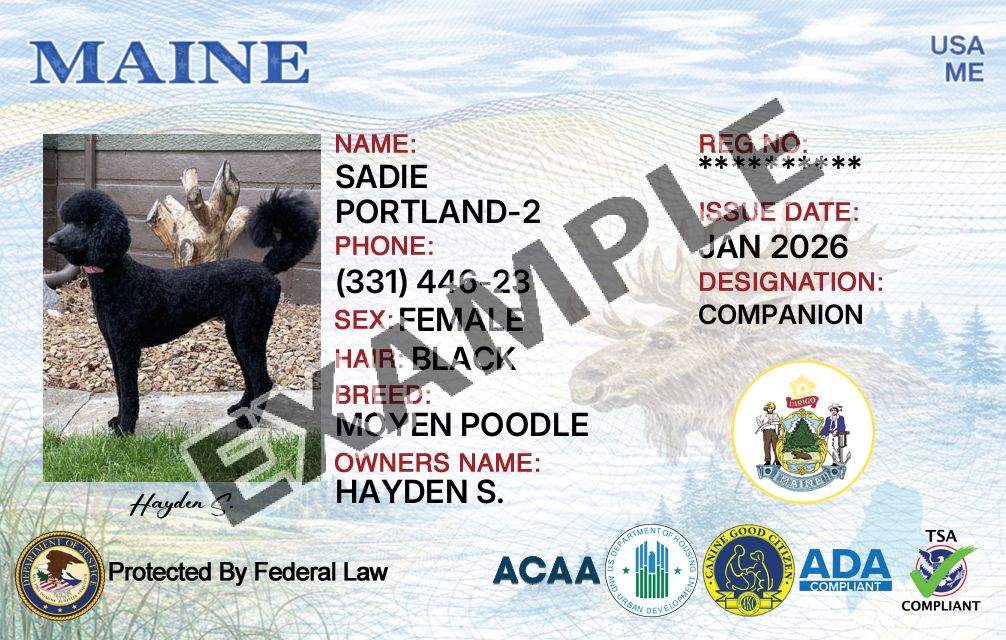
Service Dogs and Emotional Support Animals in Hancock, Maine
If you’re searching for where do I register my dog in Hancock County, Maine for my service dog or emotional support dog, the most important thing to know is that Maine dog “registration” is typically the same thing as getting a dog license in Hancock County, Maine—and in most cases, that license is issued by the town or city clerk where the dog lives (not a private registry, and not usually a county office).
This page explains how licensing works locally, what rabies paperwork is required, and how a dog license differs from service dog legal status and emotional support animal (ESA) documentation.
Where to Register or License Your Dog in Hancock County, Maine
Because licensing is handled locally, you usually register (license) your dog at the town/city office where your dog is kept. Below are several example official offices within Hancock County, Maine that handle dog licenses and/or animal control. If your town is not listed here, contact your own municipal clerk/town office for where to register a dog in Hancock County, Maine.
Hancock County Animal Control (Regional)
- Address: 50 State Street, Suite 1
- City/State/Zip: Ellsworth, ME 04605
- Phone: (207) 667-9542
- Mobile: (207) 610-9280
- Email: Not listed publicly on the office page
- Hours: Not listed
Town of Bar Harbor (Municipal Office / Clerk)
- Address: 93 Cottage Street
- City/State/Zip: Bar Harbor, ME 04609
- Phone: (207) 288-4098
- Email: Not listed on the dog license page
- Hours: 8:30 a.m. – 5:00 p.m.
Town of Blue Hill (Town Office / Clerk Services)
- Address: 18 Union Street
- City/State/Zip: Blue Hill, ME 04614
- Phone: (207) 374-2281
- Email: Not listed on the clerk services page
- Hours: Monday – Wednesday: 8:00 a.m. – 5:00 p.m.; Thursday – Friday: Closed
Town of Hancock (Town Office / Clerk)
- Address: 18 Point Road
- City/State/Zip: Hancock, ME 04640
- Phone: (207) 422-3393
- Email: hancockdeputy@hancocktownoffice.com (dog licenses)
- Hours: Not listed on the contact list page
Overview of Dog Licensing in Hancock County, Maine
What “Registering” a Dog Usually Means
In everyday conversation, people often say “register my dog,” but in Maine the required process is typically the annual dog license in Hancock County, Maine. Licensing helps connect a dog to an owner, supports local animal welfare and animal control work, and is tied to rabies vaccination compliance.
Where the License Comes From (Town/City, Not a Private Registry)
Maine law generally requires licensing in the municipality where the dog is kept. That means most people in Hancock County obtain a license from their town or city clerk. If you live in an unorganized territory, there may be a dog recorder process rather than a typical town clerk counter.
Rabies Vaccination Proof Is Central to Licensing
In most cases, a municipal clerk cannot issue a dog license until the owner provides proof of rabies immunization (with limited exceptions allowed under state rules). If you’re preparing to license your dog, plan to bring or submit your current rabies certificate.
Licensing Deadlines and Renewals
Dog licenses are typically renewed annually. Many communities treat dog licensing as a year-by-year renewal through the clerk’s office, and some places impose late fees after the renewal period. If you’ve recently moved, adopted a dog, or your puppy is reaching licensing age, it’s smart to contact your town office promptly and ask what timeline applies in your situation.
How Dog Licensing Works Locally in Hancock County, Maine
Step-by-Step: Typical Local Licensing Process
- Confirm your licensing office: Start with the municipal clerk/town office where your dog lives. This is the most common answer to where to register a dog in Hancock County, Maine.
- Gather required documents: Most offices require rabies vaccination proof; some also ask for spay/neuter documentation to apply the correct fee category.
- Apply in person, by mail, or by online process (if offered): Options vary by town. Some municipalities provide online renewal, while others handle it at the counter.
- Pay the licensing fee: Fees can differ by municipality and by spay/neuter status.
- Receive your license record/tag information: Keep documentation in a safe place, and make sure your dog’s ID tags (including rabies tag if provided by your veterinarian) are up to date.
Animal Control vs. Dog Licensing (Who Does What?)
People also search for an animal control dog license Hancock County, Maine, but animal control and licensing are often handled by different parts of local government:
- Town/City Clerk: Issues the dog license, collects required paperwork, and records the license.
- Animal Control Officer (ACO) / Regional Animal Control: Responds to complaints such as stray dogs, nuisance issues, bites, cruelty concerns, quarantine or rabies enforcement steps, and ordinance-related calls. Some ACOs may help direct residents to the correct licensing office, but they typically are not the primary licensing counter.
What If You Live in an Unorganized Territory?
Some areas may not have a typical town office structure. In that case, Maine law provides for licensing through a dog recorder process. If you are unsure whether your address is in an unorganized territory, ask your nearest town office or the county/regional animal control contact for guidance on the right path to licensing.
Why Licensing Still Matters for Service Dogs and ESAs
A local dog license is a civic requirement tied to rabies compliance and local recordkeeping. It is separate from disability-related legal definitions (service animals) and separate from housing documentation (ESAs). Many residents still need a license even if the dog is a service dog or an emotional support dog.
Service Dog Laws in Hancock County, Maine
A Dog License Does Not “Make” a Service Dog
Getting a dog license in your Hancock County town is important, but it does not grant service dog status. A service dog is defined by its role and training to perform tasks for a person with a disability. A municipal dog license is simply a licensing record for dogs living in that town.
Do Service Dogs Still Need a Local License?
In practice, many service dogs are still licensed through the local clerk like any other dog. Some fee waivers or special documentation may exist under state processes, but the licensing requirement itself can still apply. If you are licensing a service dog, ask your municipal clerk what documentation they require for any available fee waiver options.
Public Access: What Businesses Can and Can’t Require
Public access rules for service animals are generally based on disability law standards. In many situations, businesses do not require “registration papers” for a service dog, and online certificates are not the legal basis for public access. Instead, service animal access is based on whether the dog is trained to perform disability-related tasks and whether it is under control and housebroken.
Best Practice: Keep Practical Records Handy
Even when not legally required for public entry, it’s still helpful to keep your dog’s rabies vaccination certificate and local license information organized—especially for travel, boarding, grooming, or veterinarian visits. This also supports quick resolution if your dog is lost or if there is a bite/rabies-related incident.
Emotional Support Animal Rules in Hancock County, Maine
An ESA Is Not the Same as a Service Dog
An emotional support animal (ESA) provides comfort or support as part of a person’s mental or emotional health needs, but an ESA is generally not the same as a task-trained service dog. This difference matters most for public access rules: ESAs do not automatically have the same public access rights as service animals.
Dog Licensing Still Applies to ESAs
Even if you have an ESA letter for housing, you may still need to obtain a dog license in Hancock County, Maine through your town office. Licensing is a local requirement focused on identification and rabies compliance, not a designation of disability support status.
What ESA Documentation Usually Is (and Isn’t)
ESA documentation is typically a letter from a qualified healthcare provider for housing-related accommodations. It is not the same as a municipal dog license, and it is not the same as a “service dog registration.” If you’re being asked for “registration” by a landlord, clarify whether they mean your local dog license, vaccination record, or ESA documentation for accommodation.
Practical Tip: Avoid Third-Party “Registries” for Legal Status
Many people searching where do I register my dog in Hancock County, Maine for my service dog or emotional support dog encounter third-party sites selling certificates. Those products generally do not replace the official step you need locally: getting your dog licensed with your municipal clerk and staying current on rabies vaccination requirements.
Frequently Asked Questions
Register A Dog In Other Maine Counties
Select your county below to get started with your dog’s ID card. Requirements and license designs may vary by county, so choose your location to see the correct options and complete your pup’s registration.
- Androscoggin County Dog Registration
- Aroostook County Dog Registration
- Cumberland County Dog Registration
- Franklin County Dog Registration
- Kennebec County Dog Registration
- Knox County Dog Registration
- Lincoln County Dog Registration
- Oxford County Dog Registration
- Penobscot County Dog Registration
- Piscataquis County Dog Registration
- Sagasahoc County Dog Registration
- Somerset County Dog Registration
- Waldo County Dog Registration
- Washington County Dog Registration
- York County Dog Registration